
How to Store and Protect a Luxury Watch Collection at Home
A watch collection rarely becomes a collection overnight. One watch becomes three, then five, and eventually the question changes from where to keep them to how they should actually be stored.
For a smaller collection, a good watch box in the right location may be all that is needed. As the number and value of the watches grow, storage becomes more complicated. Some pieces are worn several times a week, others only occasionally. Certain automatic watches may be more convenient to keep running, while higher-value pieces may call for greater security.
There are boxes and papers to organize, straps and bracelets to store, and the simple problem of preventing watches from knocking against one another. A collector with ten watches may also have very different requirements five years from now.
For that reason, it makes more sense to think of watch storage as a system rather than a single box, safe or winder. The best arrangement is usually the one built around the collection itself and the way its owner actually uses it.
Start With How You Use Your Collection
Before choosing storage, consider which watches you reach for most often.
Many collections have an informal rotation. There may be three or four watches worn regularly, several pieces reserved for weekends or particular occasions, and others that spend most of their time in storage.
Those groups do not necessarily need identical treatment.
A watch worn several times a week should be easy to reach. There is little benefit in placing it behind several layers of storage simply because it happens to be valuable. Conversely, a watch worn twice a year does not need to occupy the most convenient position in the cabinet.
Automatic watches add another variable. Some collectors prefer selected pieces to remain running, particularly when resetting them is inconvenient. Others are comfortable allowing watches to stop between uses.
Even the physical dimensions of the collection matter. A group of slim dress watches occupies storage differently from a collection dominated by large sports watches with metal bracelets.
Understanding these habits first makes almost every storage decision easier.
Choose a Stable Storage Environment
Where watches are kept matters.
For long-term storage, a stable indoor environment is preferable to a location exposed to significant changes in temperature or humidity. Direct sunlight is also best avoided, particularly where leather straps, presentation materials or other sensitive components are involved.
Enclosed storage has another simple advantage: dust protection.
A watch left on a dresser for weeks can gradually collect dust around the bracelet, clasp and case details. It is also more exposed to the normal activity of a household. An enclosed box or cabinet reduces both problems.
Humidity deserves consideration, although there is no reason to turn ordinary watch storage into a laboratory environment. For most collectors, the practical objective is a reasonably stable residential setting rather than extreme environmental control.
The location within the home should reflect how the collection is used as well. A dressing room can be ideal for watches in regular rotation because they are close to the point where the owner gets ready. More valuable or infrequently worn pieces may be better suited to a less exposed and more secure location.
Prevent the Everyday Damage That Is Easy to Avoid
Some of the most common risks to a watch collection are surprisingly ordinary.
Two watches placed loosely in the same drawer can touch. A bracelet can rub against another case. A clasp can make contact with a polished surface. A watch placed temporarily on a stone countertop can acquire a scratch that had nothing to do with wearing it.
Individual compartments eliminate much of this unnecessary contact.
Each watch should have enough space to sit securely without being pressed against the next one. Cushions and holders should support the watch without forcing the bracelet or strap into an awkward position.
Compartment size is worth checking carefully, especially with modern sports watches. Case diameter alone does not tell the whole story. Thickness, bracelet construction and clasp design can affect how comfortably a watch fits.
Metal-bracelet watches can also consume more usable space than expected, particularly when a clasp does not fold completely flat around a cushion. A storage layout that looks generous on paper may therefore feel much tighter once the actual watches are inside it.
Accessories deserve their own space too. Spare bracelets, buckles and tools should not end up loose in the same compartments as the watches they are supposed to accompany.
Keep Everyday Watches Accessible
Security and convenience sometimes pull in opposite directions.
Imagine a collector with twenty watches who regularly wears the same four or five. Opening several drawers and searching through the entire collection every morning would quickly become irritating.
The pieces in active rotation should usually be the easiest to reach.
This can be accomplished without scattering watches around the house. A larger cabinet or secure storage system can have different areas for different purposes: accessible positions for frequently worn pieces, secondary storage for occasional watches and more protected locations for particularly valuable ones.
Collectors often change their rotation as well. A sports watch worn frequently during summer may spend more time in storage during winter. The system should make it reasonably easy to move watches between these roles.
Accessibility is not the opposite of good storage. It is part of it.
Security Becomes More Important as the Collection Grows
A conventional watch box may be entirely appropriate for a smaller collection. But the equation changes when a collection begins to represent a substantial financial value.
At that point, storage is no longer only about organization and scratch prevention.
Dedicated luxury watch safes can provide another level of protection while accommodating the particular requirements of a watch collection. Depending on the design, the interior may include individual watch positions, accessory drawers, display areas or integrated winding modules rather than the empty shelves found in a conventional general-purpose safe.
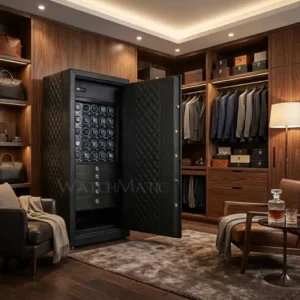
For collectors considering this type of storage, internal configuration matters almost as much as overall capacity.
A safe advertised for a particular number of watches may not necessarily suit every collection equally well. Large cases, metal bracelets, accessories and the desired number of winding positions can all affect usable capacity.
The physical installation deserves attention too.
Large watch safes can be substantial in both size and weight. Door widths, stairs, elevators, floor loading and the final installation location are worth considering before the safe arrives rather than on delivery day.
In a new residence or major renovation, there may be an opportunity to plan secure watch storage from the beginning. A safe can sometimes be incorporated into dressing-room cabinetry, a private study or another controlled area instead of appearing as an object added to an already finished room.
Not every collector needs this level of security, and there is no universal number of watches at which a safe suddenly becomes necessary. Collection value, the home, insurance requirements and personal risk tolerance all influence that decision.
The important point is recognizing when the collection has outgrown ordinary storage.
Decide Which Automatic Watches You Actually Want to Keep Running
Automatic watches create a storage question that quartz watches do not.
Leave an automatic watch unworn beyond its available power reserve and it will eventually stop. That is normal. It can be wound, set and worn again when needed.
For a simple three-hand watch, resetting it may take very little time. A watch with additional calendar or other settings can be less convenient to restart, particularly if the owner rotates through several watches regularly.
This is where watch winders can be useful.
A winder periodically rotates an automatic watch while it is not being worn, allowing selected watches to remain running and ready for use. Convenience is the key point: owning an automatic watch does not automatically mean it must spend every unworn hour on a winder.
Collectors can be selective.
Someone might keep a frequently worn GMT or calendar watch running while allowing a simple three-hand watch to stop because resetting the latter takes only a few moments. A collector with ten automatic watches may therefore need four winding positions rather than ten.
The movement itself should also be considered when choosing a winder. Different watches can have different winding requirements, so adjustable settings and independently controlled positions become useful in a mixed collection.
This approach avoids treating every automatic watch as though it has identical needs.
Organize Boxes, Papers and Service Records Separately
The physical watches are often the most compact part of a collection.
Original presentation boxes are a good example. Ten watches can fit inside a relatively modest cabinet, while their ten presentation boxes may occupy a significant portion of a closet.
There is rarely a practical reason for every original box to sit beside its watch.
Warranty cards, certificates, purchase documents, valuation records and service history also need organization, but not necessarily in the same place as the collection.
For a larger collection, maintaining an inventory can be useful. At minimum, it might record each watch’s brand, model, reference, purchase information and service history. Current photographs provide another useful record.
Collectors may also want secure digital copies of important documents, particularly records that would be difficult to replace.
Separating some documentation from the watches can make sense from a security perspective too. If one location is compromised, the physical collection and every supporting record are not necessarily lost together.
The aim is not complicated record keeping. It is simply knowing what is in the collection and being able to document it when necessary.
Display Selectively Rather Than Displaying Everything
Collectors generally buy watches because they enjoy them, so keeping every piece permanently hidden can feel counterintuitive.
At the same time, open display exposes watches to more dust, accidental contact and unnecessary visibility.
A useful compromise is selective display.
A few favorite pieces can occupy glass-fronted compartments or enclosed display positions, while the rest remain concealed. The displayed watches can change as the owner’s rotation or interests change.
This can work particularly well when a collection is incorporated into a dressing room or private study. A small number of watches becomes part of the space without making the room resemble a retail showroom.
Displaying fewer pieces can also make individual watches easier to appreciate. A collection of thirty watches does not necessarily need thirty visible positions.
For many homes, restraint works better.
Treat Insurance as a Separate Layer of Protection
Physical storage can reduce risk, but it does not address every possible loss.
For a high-value collection, insurance and documentation should be considered separately from the box, cabinet or safe in which the watches are kept.
Coverage varies considerably by insurer, policy and jurisdiction. High-value pieces may require valuations, photographs, individual declarations or particular security arrangements. Collectors should therefore confirm requirements directly with an appropriate insurer rather than assuming ordinary household coverage is sufficient.
This is another reason accurate records matter.
If a watch is lost, stolen or damaged, photographs, reference numbers, purchase documentation and service history can make identification and valuation considerably easier.
Those records should be updated when the collection changes. Buying three new watches during the year but leaving an inventory or insurance schedule unchanged creates an obvious gap.
A strong safe and good documentation solve different problems, and serious collections may benefit from both.
Leave Room for the Collection to Change
Collectors tend to underestimate future storage requirements.
The cabinet that seems spacious with eight watches can feel very different after several more acquisitions, especially once straps, bracelets, travel cases and accessories begin occupying the same space.
Some spare capacity is therefore useful.
That does not mean buying the largest safe or cabinet available. It means avoiding a configuration that is already nearly full on the day it is installed.
Flexibility can be more valuable than raw size. Adjustable compartments, accessory drawers and independently controlled winding positions allow the storage system to change with the collection.
It is worth thinking about the type of watches that may be added too.
A collector currently focused on dress watches may later become interested in larger sports pieces. Someone who owns mostly manually wound watches today may eventually acquire more automatics. Storage that can accommodate those changes is less likely to need replacement.
For large cabinets and safes in particular, this matters because replacing the storage itself can be far more complicated than buying another tabletop watch box.
Build the Storage Around the Collection, Not the Other Way Around
There is no single correct setup for storing luxury watches at home.
A collector with five watches worn regularly may be perfectly served by a quality watch box in a stable, sensible location. Another collection may require a combination of secure storage, winding positions, accessory drawers, documentation and insurance.
The useful question is not simply, “What is the best way to store watches?”
It is, “What does this particular collection need?”
Watches that are worn frequently should be convenient to reach. Individual pieces should be protected from unnecessary contact. Security should increase when the value and circumstances of the collection justify it. Automatic watches can be kept running selectively when doing so makes ownership more convenient. Boxes, papers and records should be organized without consuming the space intended for the watches themselves.
And there should be room for the answer to change.
A watch collection is rarely static. New pieces arrive, wearing habits shift and what once seemed like more than enough storage eventually becomes crowded.
The best storage system is therefore not necessarily the most elaborate one. It is the one that protects the collection while remaining practical enough to be used every day.